“Breathwork” tends to get filed under spiritual practice, something you either believe in or you don’t. That’s part of why, when people are struggling, many reach for psychotherapy before they’d ever consider working with the body: therapy sounds evidence based, breathing exercises sound like a vibe.
Psychotherapy deserves that trust. Understanding yourself, working through what’s happened to you, having language for your experience, none of that gets replaced by breathing differently, and I’m not suggesting it should. But there’s a layer of healing that happens beneath language, in the body itself, and that layer has real physiology behind it. One of the main players is a nerve most people have never heard of: the vagus nerve.
What the vagus nerve actually does
It runs from your brainstem down through your neck and chest into your digestive system, touching your heart and lungs along the way. It’s the main pathway of your parasympathetic nervous system, the part responsible for rest, digestion, and recovery, as opposed to the sympathetic nervous system, which handles fight or flight.
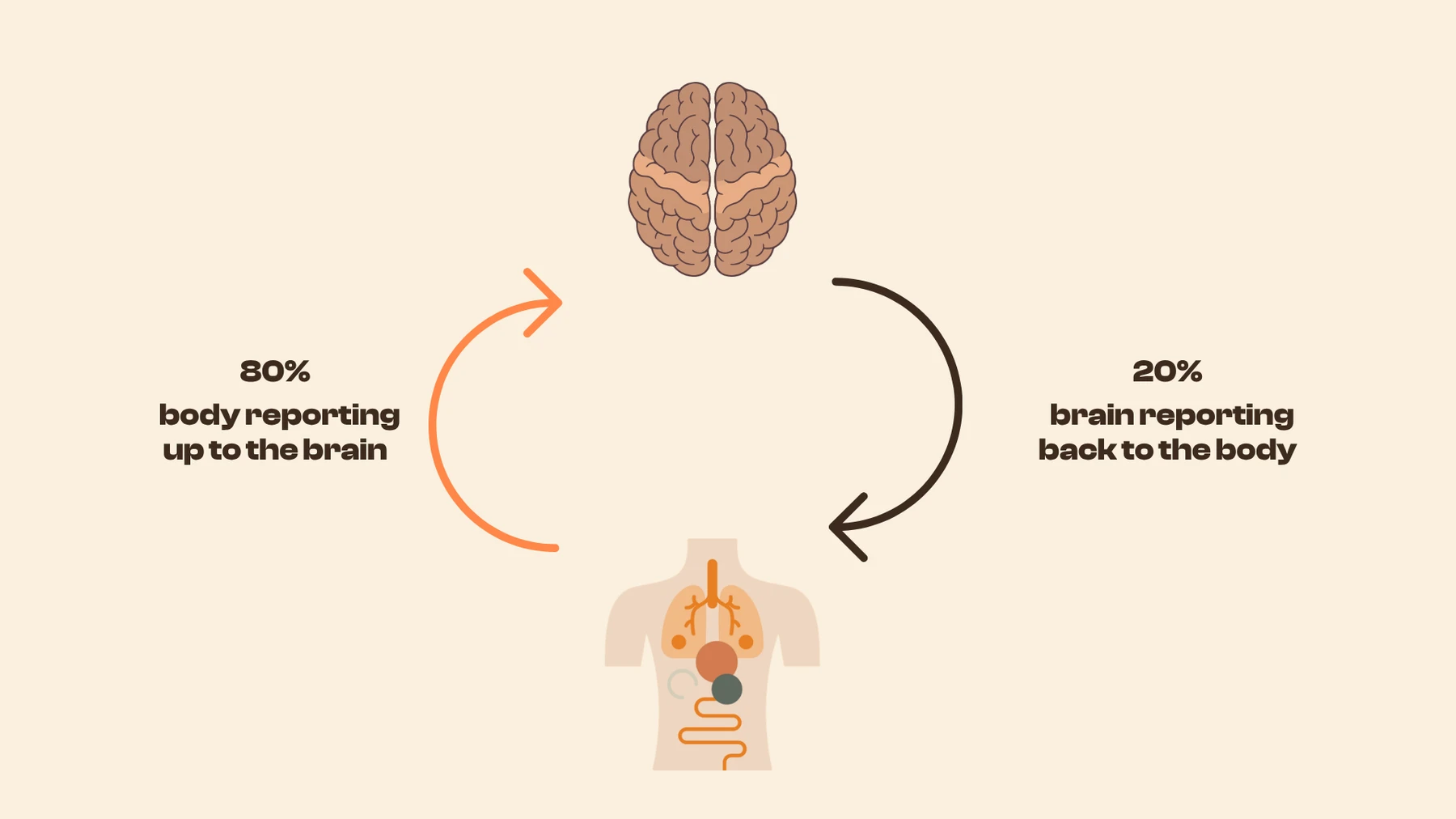
Here’s the detail most people don’t expect: roughly 80 percent of the vagus nerve’s fibers carry information upward, from body to brain. Only around 20 percent carry signals back down. Your body is reporting to your brain far more than your brain is instructing your body.
Your body’s report decides your state
When your breathing is shallow, your shoulders are tense, and your digestion feels off, your vagus nerve is carrying all of that upward: not relaxed, not safe. Your brain, trusting the body’s report, stays on alert. It’s not overthinking, it’s just believing what it’s being told.
Where breathwork fits in
Slow, extended exhales appear to directly engage the vagus nerve. Researchers have proposed a few explanations for why: pressure receptors in your blood vessels responding to a slower breathing rate, stretch receptors in your lungs, and your brain interpreting the slower breath itself as a signal of safety. Breathing at around 5 to 6 breaths per minute, with a longer exhale than inhale, is one of the more studied ways to work with this.
Being simple and scientific also means being honest about the limits of what’s known. The exact mechanism is still being researched, several explanations are proposed rather than fully proven. What’s well supported is the outcome: slow breathing measurably shifts markers of vagal activity and calms the body’s stress response.
Follow the circle for a few breaths before reading on.
That’s what’s happening physiologically in a breathwork session, underneath any spiritual framing at all. You’re using your breath to change the message going up that 80 percent, and your nervous system, believing the body’s report the way it always does, starts to stand down.
This isn’t a replacement for anything else that helps you heal. It’s simply proof that your body was never separate from that process to begin with.
RELATED READINGHow a safe space is actually created at AURA
More on the vagus nerve, and the nervous system science behind why a well held space matters.
Still have questions about any of this?
Book a call to talk it through